Start at the end.
It is opening day. The Metrc tags are live, the safe is bolted to the floor, and the first customer is at the counter with a photo ID. Two people in New Jersey can be standing in exactly that spot on the same morning. One of them bought a business that already existed. The other built one from a paper application. From the sidewalk, you cannot tell them apart.
Almost every buy-versus-build comparison runs the calendar forward, which flatters the build side, because forward math starts with the application fee. Run it backwards — from opening day to the first check written.
Day 0: two stores that look identical
Both owners are Class 5 retailers. Both collect the 6.625% Sales and Use Tax plus a local cannabis transfer tax of up to 2%. Both are among the 323 dispensaries the Commission counted open as of May 15, 2026. Both sell into the same statewide number — roughly $100.9 million in August 2026. Identical from here forward. Nothing alike behind them.
Minus 90 days: one owner is hiring, the other is waiting on a meeting
The buyer is in diligence, which typically runs 30 to 90 days, watching a calendar they do not control. Ownership changes here are not signed off by an administrator on a Tuesday afternoon. They are approved by the Commission at a public meeting, and two are left in 2026 — October 29 and December 10. Miss one and the closing moves to the next. That single fact reorders more cannabis deals than anything else I deal with.
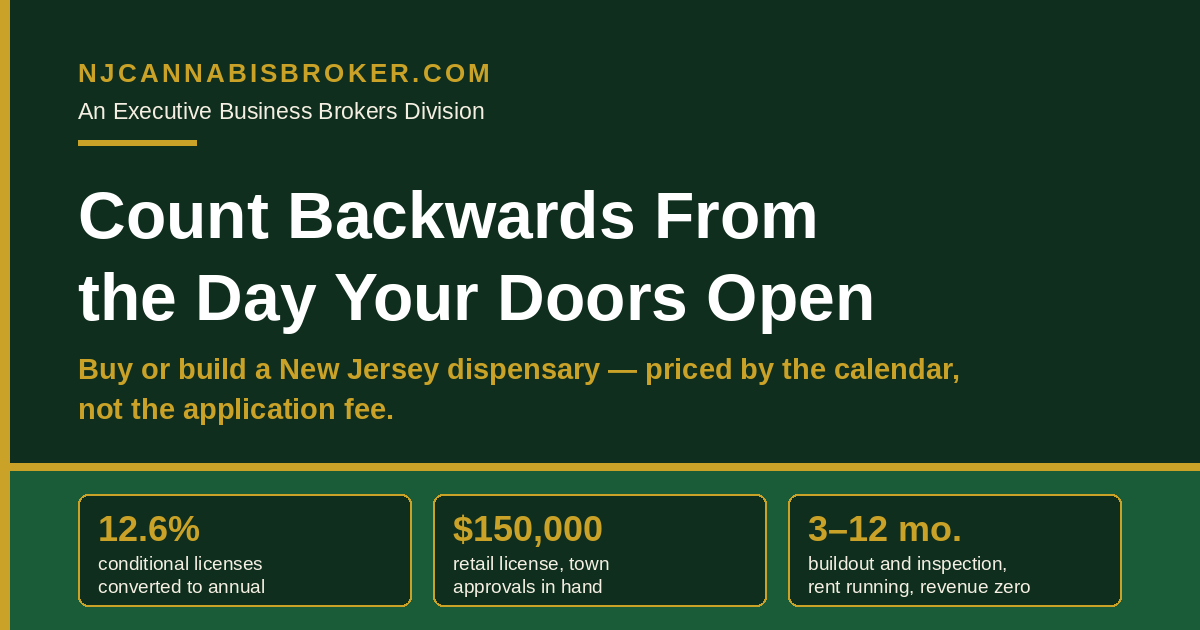
The builder is inside the buildout-and-inspection phase, which licensing consultants put at three to twelve months. Rent is being paid. Revenue is zero. That gap is the most underbudgeted line in the whole exercise.
Minus 9 months: a letter of intent, or a lease
The buyer signs an LOI, opens diligence, and starts assembling a Commission filing. Budget the state's $20,000 fee for a change of more than 50% of ownership, plus $10,000 if the location is changing, as a cost of the transaction rather than an afterthought. And confirm the seller is even eligible: under N.J.A.C. 17:30-9.3 there is no change to more than half the ownership interest until two years after the business commences operations.
The builder is standing in front of a town. Under N.J.A.C. 17:30-7.6 a conditional licensee has 120 days — extendable by 45 — to establish site control and secure municipal approval. Municipal conditional approvals have been running four to five weeks; annual approvals and conversions, twelve to twenty-six. I walked that side of it in the municipal approval checklist. The short version: the town clock, not the state clock, kills build timelines.
Minus 18 months: where the budgets stop resembling each other
The builder's numbers, as the consultants publish them: retail buildout of roughly $250,000 to $300,000, all-in startup anywhere from $250,000 to $2 million depending on market and scale. New Jersey cannabis space runs $15 to $40 per square foot, in stores averaging near 1,800. Multiply your rent by your buildout months and add it in. Most first-time budgets do not.
The buyer's number is a multiple, not a budget. Dispensaries trade at roughly 3x to 6x EBITDA, most closed deals between 4x and 6x, distressed situations toward 2x. It is a bigger check. It also buys a revenue line that starts the morning after closing instead of eighteen months later. How that number gets built is its own post.
Minus 30 months: the application, and the number nobody quotes beside it
Here is where the forward version sells the dream. The fees are almost nothing: $200 to submit a conditional application and $800 on approval, $400 and $1,600 on the annual side, and a standard retail licensing fee in the $10,000 range.
Now the number that belongs beside it. Of roughly 2,435 licenses New Jersey had awarded, about 1,657 were conditional — and only 308 had converted to annual, against 397 operational licenses in total, per the state's December 2025 figures. That is a conversion rate near 12.6%. Trade coverage in February 2024 put the expected conditional failure rate at 65% to 80% — a dated estimate, but the conversion math since has not improved enough to wave it off.
You can watch that failure rate get priced in real time. On the open listing boards this week: a portable Class 5 retail license at $69,000. A retail license with township approvals already in hand at $150,000, reduced, no real estate attached — someone completed the hardest part of a build and could not finish the rest. A Jersey City retail opportunity at $125,000. A Somerset manufacturing facility advertised as a fire sale at $249,000. Those are not bargains falling out of the sky. They are the build path's dropout rate, converted into asking prices.
And now the honest case for building
Three things run the other way.
- Basis. A built store's cost basis is a buildout. A bought store's is a multiple of somebody else's earnings. Patient, well-capitalized operators build for less per dollar of enterprise value.
- No inherited problems. Unresolved compliance issues routinely take 20% to 30% off a valuation, and you buy them along with the shelves.
- You choose the town. Buying an operating store means buying someone else's site-selection decision, in a state where 358 municipalities do not permit retail at all.
One caution: the same two-year transfer lockout that constrains sellers will constrain you. Build it, and you cannot sell more than half of it until you have been operating two years.
And if the real question is only the cheapest lawful way to hold a New Jersey license, the answer is not retail at all. A Class 6 delivery license runs roughly $5,000 in total state fees, applications have been rolling since March 27, 2024, and there is no cap. The economics are their own problem — I went through those yesterday — but the door is cheap.
Four numbers, one page:
- Your months of rent before revenue. Three to twelve months of buildout and inspection, times your lease rate. This is the build path's real price, and it is almost never in the pro forma.
- Your Commission meeting date. If you are buying, the deal closes after a public meeting, not before one. October 29 and December 10 are what is left of 2026.
- Your transaction fees. $20,000 for a majority ownership change, $10,000 more for a location change — separate from, and on top of, the purchase price.
- Your walk-away point on a paper license. A $150,000 license with town approvals is either a genuine shortcut or somebody's unfinished project. Decide which before you sign the NDA, not after.
I have watched people spend three years and seven figures to open a store that a competitor bought outright, already operating, in five months. I have also watched buyers pay four turns of EBITDA for a business they could have built better themselves two towns over.
There is no universal answer here, only your own calendar run backwards. If you need revenue inside a year, you are buying, and the only real question is what you pay for it. If you have patience, capital and a town that actually wants you, building is the cheaper basis — provided you count the rent on a store that is not selling anything yet.
None of this is legal or tax advice. License transfers, ownership disclosure and entity structure belong in front of a New Jersey cannabis attorney, and the tax treatment of however you enter belongs in front of a cannabis CPA, before you commit a dollar.