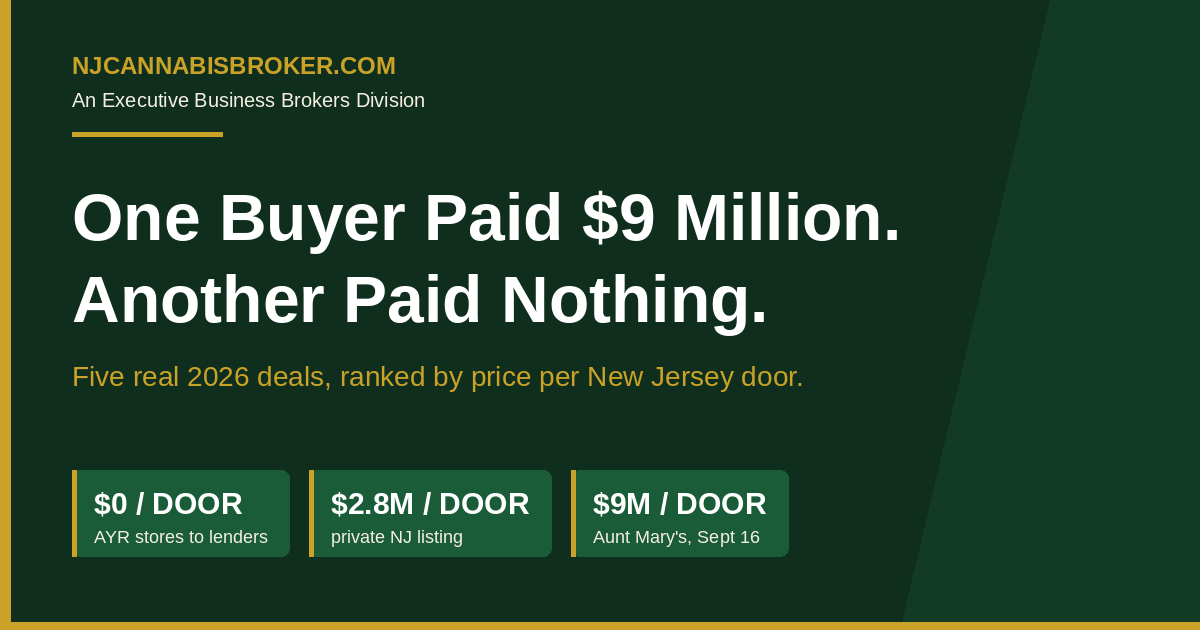
Last Wednesday, September 16, TerrAscend closed on one dispensary in Hunterdon County for $9 million. Earlier this year, three New Jersey dispensaries in Union, Woodbridge and Eatontown changed hands with no storefront price at all — they went to the lenders. Both are real 2026 New Jersey transactions.
The gap is not about which stores are better. It is about what each buyer was buying. Some version of “what would an MSO pay for my place?” comes up almost every week, usually from an owner who read one headline and quietly resized their retirement around it. Here is the ladder, bottom to top.
$0 a door: when the lender is the buyer
AYR Wellness's New Jersey retail operations — the three stores formerly branded Garden State Dispensary — went into Arboretum New Jersey LLC. Arboretum Bidco is not a rival operator. It is an entity established by AYR's own senior secured noteholders as the designated purchaser under a master purchase agreement dated November 14, 2025, signed while AYR wound down under the Companies' Creditors Arrangement Act in the Supreme Court of British Columbia. One line in the closing announcement matters here: “All requisite state regulatory approvals for the transfer of the Florida, New Jersey and Nevada operations were obtained prior to the closings.” Even a creditor takeover goes through a change-of-ownership review.
This buyer paid nothing and took control, because the equity was already worth less than the paper on top of it. If your secured debt exceeds a realistic sale price, you are not on this ladder, and the conversation you need starts with your lender.
$1.4M a door: the portfolio sweep
In July, Vireo Growth agreed to buy cultivation, manufacturing and retail assets from Cannabist subsidiaries in five states. Up to 25 dispensaries, one cultivation facility and one production asset for up to $35 million — $18.75 million cash at closing, up to $16.25 million in seller notes or stock. Three of those doors are here, in Vineland, Deptford and Mays Landing. Do the division: about $1.4 million a door, before subtracting the cultivation and production assets inside that price.
That is a distress number, and Cannabist's own disclosures explain it: a severe liquidity crisis, an inability to meet obligations as they came due. A seller on a clock gets a portfolio price, discounted again because the buyer is doing five states of regulatory work at once.
$2.8M a door: what a private seller actually asks
Now leave the MSOs. A Jersey City retailer on the open market asks $2.8 million against roughly $2.77 million of annual gross revenue at a 48.45% gross margin, in 2,681 square feet at $6,700 a month, MBE and Impact Zone certified.
Roughly one times revenue — the honest middle of this market. A private buyer — a liquor retailer, a family office, an out-of-state operator buying into a limited-license state — underwrites what the business pays an owner after tax. That is the whole problem. Adult-use cannabis is still Schedule I. The April 28, 2026 final rule reached only FDA-approved products and state-licensed medical marijuana, and the adult-use proceeding — an 11-day hearing before Chief ALJ Derek C. Julius, briefs closed August 17 — has produced no recommended decision. Section 280E still reaches an adult-use store. What that does to your return is a CPA question. It is also why the private buyer's number has a ceiling.
$2.9M a door: the healthy-portfolio price
On August 7, Vireo Growth closed on 17 PharmaCann dispensaries in Colorado for $49.0 million — about $2.9 million a door for performing, non-distressed retail.
Hold that against the rung below. A seventeen-store portfolio and one Jersey City storefront, within a hundred thousand dollars of each other per door, for opposite reasons: Colorado licenses are not scarce and New Jersey's are. Two-thirds of the state's 564 municipalities opted out. Here, scarcity does the work that scale usually does.
$9M a door: the strategic single store
Back to Flemington. On September 16, TerrAscend closed on Aunt Mary's at The Shoppes at Flemington — a store doing more than $10 million in annualized revenue — for $9 million in total consideration. It is TerrAscend's fifth New Jersey dispensary, and the company called it immediately accretive on EBITDA and free cash flow.
Read Jason Wild's sentence: “Aunt Mary's generates more than US$10 million in annualized revenue today, and we see meaningful opportunities to enhance sales and profitability through the integration of our premium brand portfolio.”
An MSO is not buying your P&L. It is buying a shelf. TerrAscend cultivates in New Jersey, so every gram it moves through its own storefront earns twice. A private buyer cannot pay for that second margin because they do not have it. That is how one buyer's number doubles another's on the same store — and why an MSO is not automatically the high bid. They pay that premium only where the pull-through is real.
It was not a wire transfer
The $9 million is $3 million in a five-year unsecured convertible debenture at 6.0% carrying an option on 35%, plus $6 million in cash payable on exercise. A headline and a closing-day wire are not the same event. Why cannabis deals get built this way is in Nobody Is Wiring You $2.8 Million at Closing. Have your attorney read the conversion mechanics before you read the press release.
So which rung are you standing on?
Three questions decide it. None is your revenue.
- Does an MSO already cultivate in New Jersey and lack a door in your county? You own the shelf they want. Top of the ladder.
- Does your store run well in a county where the MSOs already have retail? You are a private-buyer asset, priced on after-tax owner earnings near that Jersey City number.
- Is your secured debt larger than either figure? You are on the AYR rung, and saying so early is how you keep control of the ending.
The arithmetic under these numbers is in What Separates a $69,000 License From a $9 Million Dispensary.
- Map the cultivators, not the retailers. Find the Class 1 holders with product moving and no storefront within twenty minutes of you. That is your strategic-buyer list, and it is usually two or three names long, not twenty.
- Separate the headline from the wire. Ask on the first call what is cash at closing and what is paper. The Aunt Mary's structure is the norm, not the exception.
- Run your own after-tax number. Revenue is not what a private buyer underwrites. Ask your CPA what the business actually pays an owner once 280E is applied, and work from that.
- Price your scarcity, not your square footage. If your municipality capped retail and is not issuing more, that cap sits on your balance sheet even though your accountant never posted it there.
- Know your debt position before the first meeting. If secured debt exceeds a realistic enterprise value, the meeting you need is with your lender — while you still have leverage.
Five rungs, one state, one year, and a spread from nothing to nine million dollars a door. That is not a market in chaos. It is a market pricing different things for different buyers — and most owners never learn which buyer they were built for, because they only ever talk to one. Forty years of New Jersey transactions and the pattern has not moved: the owner who knows who their three logical buyers are gets a number. The owner who waits for the phone to ring gets an offer. Those are not the same thing. If you want to know which rung you are standing on, that is a conversation, not a valuation report, and it costs nothing — and if you are on the other side of the table, our current New Jersey listings are here.