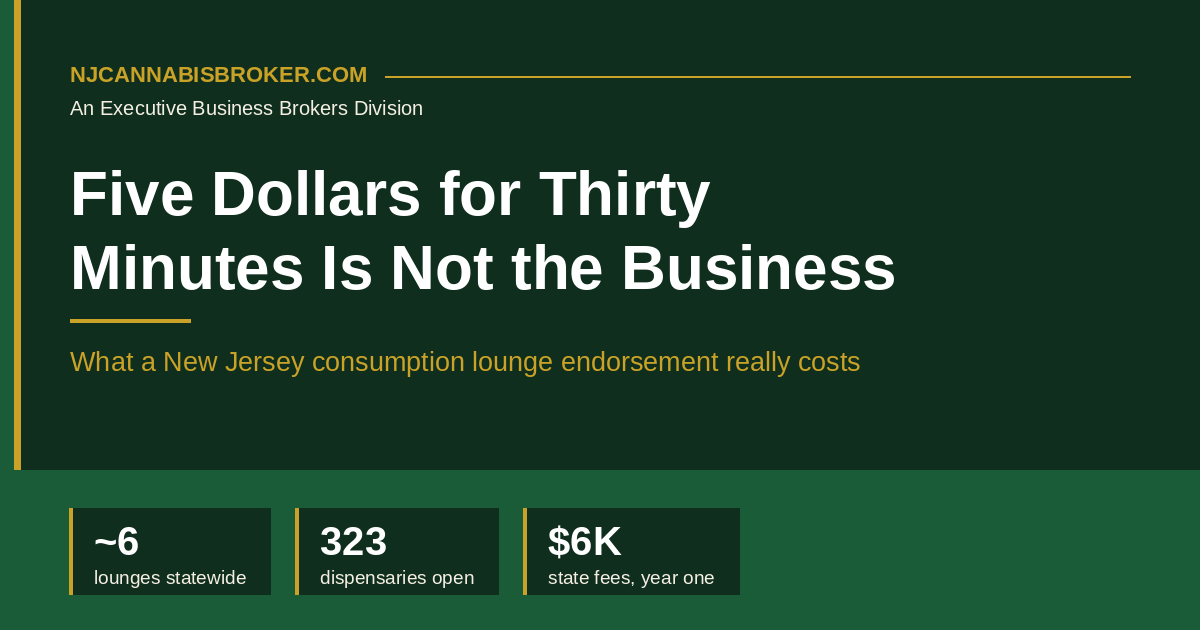
A New Jersey consumption lounge charges about five dollars per thirty minutes of seat time.
Ten dollars an hour. A twenty-seat room, every seat filled, ten hours a day, seven days a week — a rate nobody hits — grosses about $730,000 a year. You will run a fraction of that, and owners are building two-hundred-thousand-dollar rooms around it. So be clear what a NJ cannabis consumption lounge is: not a revenue line, but a change to the store wrapped around it.
The scoreboard, fourteen months in
The Commission approved the first four consumption area endorsements on July 15, 2025 — High Rollers and SunnyTien in Atlantic City, Gynsyng in Merchantville, URB’N in Newark. Xena in Jersey City followed 4–0 on June 18, 2026.
Now count: roughly six lounges against 323 dispensaries open across all 21 counties as of May 15, 2026. Under two percent, more than a year after applications opened. That is not a demand signal. It is a cost signal.
What the state charges, and what the room costs
The fees are trivial: $200 to submit, $800 on approval, and initial licensure of $5,000 for a standard retailer or $1,000 for a microbusiness.
The build is not. N.J.S.A. 24:6I-21 requires an indoor consumption area to be structurally enclosed, separated by solid walls or windows, entered only through an interior door — and where smoking is permitted, to meet all ventilation requirements applicable to cigar lounges under the Smoke-Free Air Act. In a contractor’s scope: a dedicated HVAC zone at negative pressure to your sales floor, carbon filtration sized to keep odor off the street, an engineer’s stamp, a commissioning report. Not a partition wall. Against buildouts already running $250,000 to $300,000 for the store itself, a compliant lounge is a second construction project — and municipal approval comes first. Jersey City runs a Cannabis Consumption Board that signs off before the Council.
Same store, two versions
The floor plan
Take a 3,000-square-foot Class 5 retailer in an opted-in town. Before: selling floor, queue and vault. After: six to eight hundred of those feet become a room that rings up nothing directly. At the $15 to $40 a square foot New Jersey cannabis space commands, that is rent moved from a productive use to a speculative one, every month, whether anyone sits down.
The payroll
Before: budtenders, a manager, security. After: all that, plus somebody watching the room every hour it is open. N.J.A.C. 17:30-14.10 requires 21-and-over access with photo ID, bars service to a visibly intoxicated consumer, and keeps on-duty staff from consuming there. Not the register’s job.
The revenue line
Before: product sales. After: product sales, plus ten dollars an hour a head, minus the cost of the room. And here is the assumption that breaks most pro formas: under 17:30-14.10 a retailer may let a person bring personal-use cannabis into the area, and may not stop a registered patient bringing in medical product. Seat time does not automatically become a sale — and you cannot sell them anything else either, since the statute bars alcohol, tobacco and nicotine sales and bars operating as a retail food establishment. The café economics that carry lounges in every other hospitality business are off the table.
What Nevada already learned
More than 99 applicants chased Nevada lounge licenses. As of late 2025, exactly one state-regulated lounge was open — Dazed! inside Planet 13 — with 21 conditionally approved and unlaunched, and none of the ten social equity set-asides open at all. Smoke and Mirrors opened February 2024 and closed April 4, 2025: fourteen months. Nevada makes applicants show $200,000 of liquidity before opening, which is a regulator telling you what the room costs to survive.
Who it actually makes money for
New Jersey has no Strip. It has Atlantic City, and PATH-accessible storefronts within reach of a New York consumer with nowhere legal to consume on that side of the river. Three profiles work:
- The tourism store. The Boardwalk. No accident that most of the first six lounges sit in Atlantic City or a transit city.
- The commuter-corridor store near a PATH or NJ Transit stop, serving customers who live under no-smoking leases.
- The store that has stopped competing on price. With flower near $8.09 a gram, a lounge is one of the few differentiators a competitor cannot copy by Friday — copying it needs their own town to say yes first.
Everybody else is buying an expensive room in order to collect ten dollars an hour.
And you only get one
Since April 20, 2026, a Class 5 retailer can operate three locations. But the Commission’s application guidance limits an entity to one consumption area, regardless of how many Class 5 licenses or medicinal permits it holds. Have counsel confirm how that reads against your structure. If it holds, a lounge is not something you roll out across a chain as you grow — it is a single, permanent bet on one address, which makes which address the bigger question.
- Square feet surrendered, times rent per foot. The room’s annual carrying cost before you build anything.
- Your mechanical engineer’s number for a negative-pressure, carbon-filtered zone. Get it before the application.
- Your town’s answer. Is there an ordinance permitting a consumption area at all, and who signs the CRC form?
- Incremental basket, not session fees. What does a lounge visitor spend over a walk-in? If you cannot defend it, you do not have a model.
- Staffed hours at your loaded labor rate. A room you cannot staff on a Tuesday afternoon is a room you cannot open.
I like consumption lounges. New Jersey will have fifty eventually and the early operators will own the category. That is a different sentence from “the endorsement pays for itself,” and owners keep hearing the first when I say the second.
A buyer will not price a lounge as a revenue stream, because ten dollars an hour is not one. They price it as scarcity — a second municipal approval, at a specific address, in a state where most towns said no to the first. Same reason a license with a finished business behind it is worth multiples of a license alone. So: Boardwalk or two blocks from a PATH station, build it, before a competitor spends the one endorsement their company gets. A highway store in a county nobody visits, put the money into the margin you already have. None of this is legal advice; ventilation and municipal questions belong with your cannabis attorney. To find out what either version is worth, start a confidential conversation.