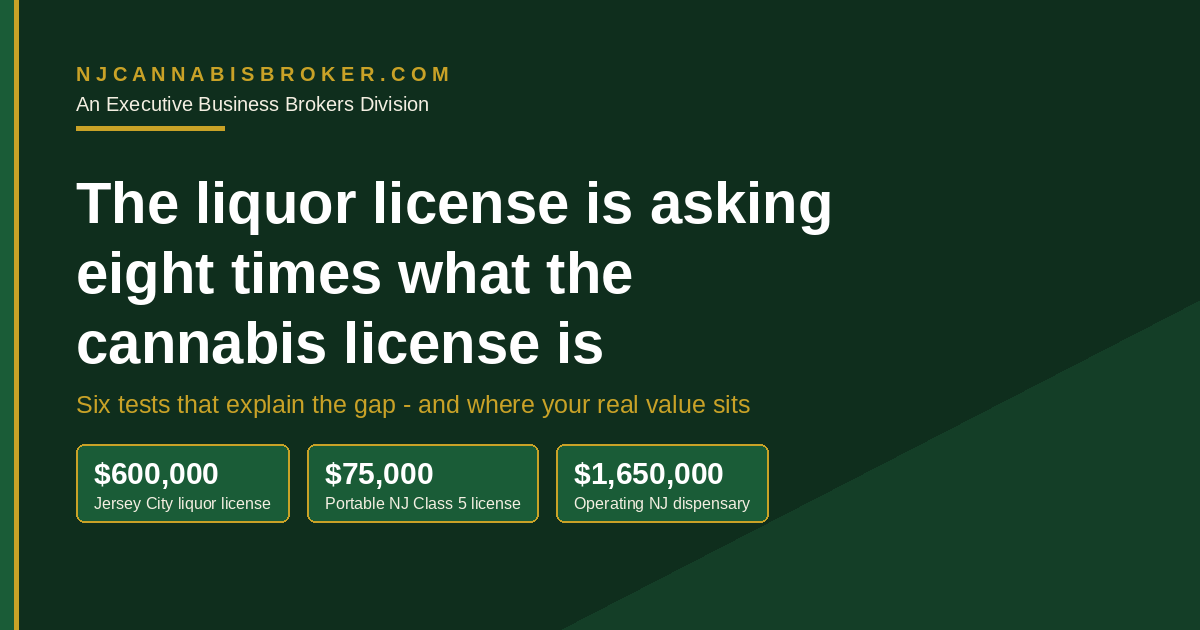
On one national listing board this morning, a Jersey City liquor license with no business attached is asking $600,000. On the same board, the same morning, a portable New Jersey Class 5 cannabis retail license is asking $75,000. Both are paper that is worth anything only because the state refuses to print more of it.
I hear the liquor comparison constantly. For anyone who has done business in New Jersey for a decade, the liquor license is the only scarcity asset they have watched appreciate, and an owner holding a Class 5 reasons the same way: limited supply, towns that say no, therefore the paper is the prize.
It is the wrong comparable — wrong in six testable ways, each pointing at where the value in your business actually sits. Those are asking prices, what sellers hope for rather than what buyers paid. The tests hold either way.
Test one: permanence
For most of a century a liquor license renewal was a formality you could repeat forever while the license sat in a drawer. P.L.2023 c.290 changed that. Under N.J.S.A. 33:1-12.39 as amended, effective August 1, 2024, a license “shall not be renewed if the license has not been actively used in connection with the operation of a licensed premises within two consecutive license terms” — and even then the municipality “may in its discretion extend the period during which the license may remain inactive for an additional year.”
Three terms of nothing, and the asset survives. Now read N.J.A.C. 17:30-9.3. A cannabis business that ceases operations inside its first two years cannot transfer its license at all: it is abandoned and returned to the Commission. Not discounted. Returned.
Verdict: the liquor license survives three years of nothing. The cannabis license may not survive one bad quarter.
Test two: portability
Person-to-person and place-to-place liquor transfers are ordinary municipal business, and P.L.2023 c.290 went further, letting licenses move between municipalities for the first time in nearly a century — reportedly putting roughly 1,356 dormant licenses back in play.
Cannabis sits at the opposite end: the license cannot be assigned to another party, nor to another premises. Moving your store is a material change under N.J.A.C. 17:30-9.2 requiring an amended application and a $10,000 fee before implementation, and the receiving town has to want you.
Verdict: one of these assets travels. Yours is nailed to an address.
Test three: who signs off
On the liquor side the issuing authority is your municipality, and brokers who do this work put a transfer at roughly 90 to 180 days from filing. That is a municipal calendar problem, not a state one.
In cannabis you need the town and the Commission, whose Board must approve an ownership change before it is effectuated, at $20,000 for a majority transfer, with the two-year lockout on top. I walked that calendar in how long a New Jersey transfer really takes.
Verdict: one approval versus two, and only one of them meets on a published schedule.
Test four: collateral
Here the comparison holds, and owners are right. A New Jersey liquor license “cannot be pledged to a creditor, but it may be transferred if approved by the issuing authority.” Lenders wanting security pledge the membership interest in the entity that holds the license and file UCCs against that, and some will not do even that. Cannabis is in the identical position, with most banks not in the room. Structure nothing around either without your attorney.
Verdict: a tie. Neither piece of paper is collateral in New Jersey, whatever a lender says on the phone.
Test five: carrying cost
One listing is a Woodland Park 44D described as a pocket license — no premises, no staff, no inventory — asking $395,000. Keeping it alive costs a renewal fee and, now, a municipal hearing on whether the holder has taken “significant steps to activate the license.”
A cannabis license that is not open costs you rent on a premises you had to control before the state would license you, payroll on people the state had to badge first, training hours under N.J.A.C. 17:30-9.8, and the two-year clock.
Verdict: a liquor license waits for free. A cannabis license charges you rent to wait.
Test six: what the paper earns alone
Neither earns a dollar alone. What matters is the price when you pull the paper off the business. Detached liquor licenses this morning: Jersey City $600,000, Atlantic City $525,000, Lodi $500,000, Fort Lee $498,000. Detached cannabis licenses on the same board: a portable Class 5 at $75,000, Somerset manufacturing at $249,000, a fully approved Atlantic County annual retail license at $300,000.
Now the ones with a business attached: a Hudson County dispensary at $1,650,000 on roughly $400,000 of cash flow, a Union County store at $795,000, an Essex County store at $850,000.
Verdict: detaching a liquor license barely dents the price. Detaching a cannabis license removes most of it.
The test that is not on the list
Five of six go against the cannabis license, and the wrong lesson is that you own a weak asset. You own a different one, priced against the wrong thing.
A liquor license is priced as an asset because it is permanent, portable and attached to nothing. Yours is priced as an attachment, because that is what New Jersey built it to be. Your comparable is a cash-flowing New Jersey business with a regulatory moat, and those trade on earnings — roughly 3 to 6 times EBITDA, most closed dispensary deals landing in the 4 to 6 range. That is the arithmetic in what separates a license from a dispensary, and why the license is the one thing in your deal that is not yours to sell.
The distance between $75,000 and $1,650,000 on one board on one morning is not a license premium. It is the business. The moat — two-thirds of New Jersey's 564 municipalities still opted out — only lets the business hold the price.
- Closed New Jersey dispensary transactions at a price per door, not asking prices on a board.
- Your own trailing twelve months of EBITDA, normalized, against a 3x to 6x range.
- Operating cannabis listings in your county with disclosed cash flow — the only listings that price a business rather than a permission slip.
- Your lease term and assignment language, because a buyer prices the address as hard as the license.
- Your last two years of CRC correspondence, which is what a buyer's counsel will read before they price anything at all.
When an owner opens with the liquor comparison, I know two things before we go further: they believe the hard part is already done, and they have not had the business valued. Both are fixable in an afternoon. Nothing here is legal or tax advice — the transfer, lockout and pledge questions all belong with your cannabis attorney and your CPA. But on the valuation question I will be blunt: the paper is not the prize. The paper is the permission. What a buyer pays for is the twelve months of operating history stapled to it, and that is the part you can still change before you go to market. If you want to see what is currently trading in New Jersey, the current listings are the fastest education available.