Your New Jersey medicinal cannabis permit number is on a piece of paper you can find in under a minute. MC, MM or MRE, then six digits.
Since the fifth of this month there has been a DEA application with a box for that number. Almost nobody here has filled it in.
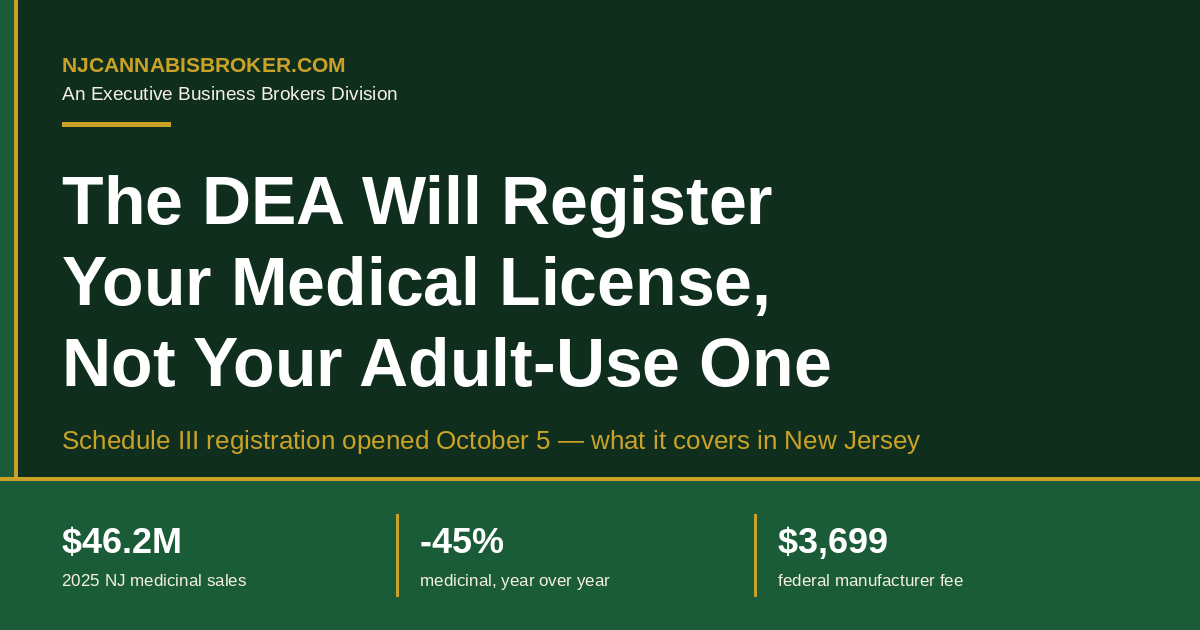
Most operators treat the medicinal half of their license as a vestigial organ, and the numbers encourage it. The state certified $46.2 million of medicinal sales in 2025 against $1.118 billion recreational, down 45 percent year over year and down another 42.3 percent in April. It is the small, shrinking, annoying half. It is also the only half the federal government will register.
Five questions follow, in the order of what it costs you to get each one wrong. Cheapest first.
Does DEA registration cover my New Jersey adult-use license too?
The Acting Attorney General signed a final order moving two narrow categories of marijuana to Schedule III, effective immediately, on April 22, 2026: FDA-approved marijuana products, and marijuana handled under a qualifying state medical license. Everything else stayed put, adult-use expressly included.
The question is not whether you are a cannabis business, but which of your permits is which. On the Commission's operating count from May 14, 2026, New Jersey had 57 medical dispensaries, 16 medical cultivators and 12 medical manufacturers running, against 323 adult-use retailers and 137 adult-use cultivators and manufacturers. The door opened for the first column, not the second. Get it wrong and you have spent a nonrefundable fee on a registration your license cannot support.
Am I still in time?
Filing inside the first sixty days after publication bought the right to keep operating during review, plus a six-month decision commitment, and the law-firm and trade write-ups put that window's close at or about June 22, 2026.
The online tool for the manufacturer, distributor and laboratory application had been listed as "coming soon" since May. It went live on October 5 — roughly three and a half months after that window closed. Whether a filing made today carries the same protection is a question for your cannabis attorney.
Does one registration cover my second building?
Every medicinal permit on the state's published list is issued to a named site with its own expiry, and the current crop runs to December 31, 2026. The federal scheme works the same way and always has: a separate registration for each principal place of business, per the DEA's long-standing reading of 21 CFR 1301.12(a).
Cultivate in one town, manufacture in a second, dispense in three others, and that is not one application. It is five, across three fee categories. Get this wrong and you have a site that cannot lawfully handle the product it was built for.
If I register the medical side, what happens to the adult-use side?
Registration for state-licensed medical operators opened on April 28, 2026, and the application asks directly whether the applicant will also handle recreational marijuana. Counsel writing the week the order landed flagged the hazard plainly: federal treatment now runs down the middle of one company, and the medical side's Schedule III standing can be put at risk by how you run the other side.
Almost every operator of consequence here holds both. Keeping the two apart — inventory, records, rooms, staff — stops being housekeeping and becomes the thing protecting the registration.
Does it come with the business when I sell?
The application that went live on October 5 asks for your state license number and its expiry, which makes it natural to assume the federal registration travels with the state one. It does not. The rule is one sentence: no registration, and no authority conferred by it, may be assigned or transferred except on conditions the agency designates, and then only with written consent.
So your deal structure is a federal question too. An asset sale puts a new entity in the chair, applying on its own facts and inheriting none of the seller's history. An equity sale, where the same registrant changes owners, may be treated differently. I walked the New Jersey side of that choice in an earlier piece on asset sale versus equity sale; which way the federal layer falls is a question for your attorney.
- $3,699 — manufacturer, one year, nonrefundable.
- $1,850 — distributor, one year, nonrefundable.
- $296 — analytical laboratory, one year, nonrefundable.
- $794 — dispensary, on the older application, by bank transfer rather than card.
- None of them buys interstate shipment, a transferable registration, or any change to your adult-use tax position.
What the public record will actually tell you
The broader question — whether all marijuana moves to Schedule III — was stayed by the chief administrative law judge on September 29, 2026 and has not restarted. The medical carve-out is not a preview; for now it is the whole of it. So the paperwork is the story, and the paperwork is public: the signed order, the two rules above, and the Commission's own permit lists and counts.
What it does to a price is simpler than all of it. A file showing a federally registered medicinal permit, clean separation from the adult-use side, and an application filed on time is a different file from one showing a state permit and a shrug — and it adds a clock alongside the Commission's, which I counted out in the ownership transfer timeline.
The half of your license you have been writing off is the half the federal government just put a number on. I am not telling you to register, and certainly not what it does to your tax position — the 280E question has retrospective angles that need your cannabis attorney and your CPA, not your broker. I am telling you it is now a line item in diligence. Out-of-state buyers will ask whether the medicinal permit is federally registered, whether the registration survives the structure proposed, and whether anyone has looked. Have the answer ready.