On October 5 Curaleaf raised its hostile offer for Aurora Cannabis to an implied US$5.00 per Aurora share — US$1.00 in cash plus 0.4013 Curaleaf shares — lifted its maximum consideration to US$6.00 and pushed the expiry out to December 4. Boris Jordan said Curaleaf was enhancing its proposal “despite Aurora’s refusal to engage and provide access to customary due diligence.”
Every number in that paragraph is public. The bid, the exchange ratio, the cap, the deadline, even the refusal to open the books.
Now try to price one dispensary in Hamilton or Hackensack. New Jersey publishes quarterly sales, licence counts, fee schedules and enforcement actions. It does not publish one single input a buyer needs to reach a price. That is not a transparency complaint. It is a working condition, and it is not even the problem. The problem is that buyers and sellers quietly put something else in each gap and then treat the substitute as the number.
Six of them, in the order a buyer asks.
1. What the last comparable store actually sold for
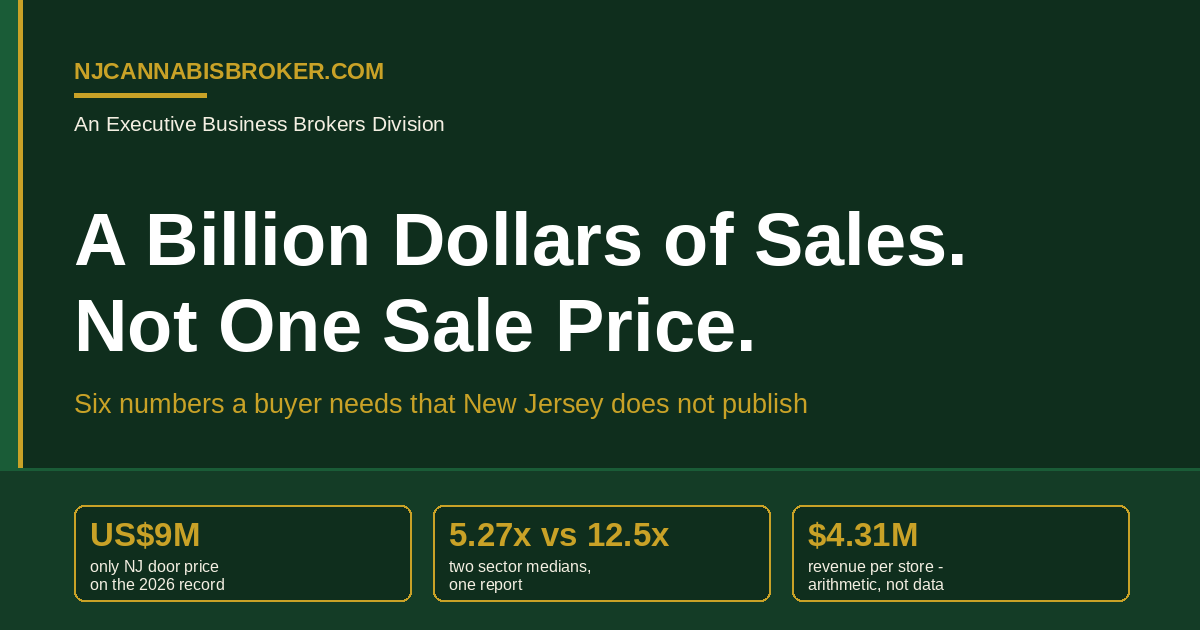
The industry’s monthly deal tracker at cann.dev covered September 2026 and reported no completed or announced New Jersey transaction for the entire month. Its Northeast section says there was none. The one single-door New Jersey price in the 2026 public record is TerrAscend’s purchase of Aunt Mary’s in Hunterdon County, closed September 16 for US$9 million — US$6 million in cash and a US$3 million five-year unsecured convertible note at 6 percent. That price is public for exactly one reason: a listed company had to file it.
Privately held New Jersey stores change hands every quarter and file nothing. The price lives in a purchase agreement in two law firms’ document rooms.
2. The multiple it traded at
This is the substitution you can catch in the act. That same September report cites a sector median of about 5.27x EV/2026 EBITDA from one source and a 12.5x median from analyst coverage in the same article, and does not reconcile them. Both are public-company figures. Industry benchmarks for completed single-store transactions have long sat in a much lower band, commonly quoted as three to six times trailing EBITDA — a range wide enough to double a price.
Whatever a particular New Jersey store traded at is on the seller’s closing statement, and that goes to the seller’s accountant and no further.
3. What the store itself takes in
Divide the statewide total by the licence count and you get the quoted figure — roughly $4.31 million of revenue per New Jersey dispensary. It is arithmetic, not a measurement. A West Milford retailer on the market now reports just over $2.2 million gross in twelve months. The Aunt Mary’s store TerrAscend bought does more than $10 million. The average sits between two businesses with almost nothing in common, and the statewide number hides the distance between them. Per-unit pricing hides the same way, as I showed earlier this month.
The honest version is a store’s own point-of-sale export beside its bank statements, and you see those after you sign a non-disclosure agreement.
4. What leaves without being sold
There is no New Jersey shrink figure. Not by store, not by county, not statewide. The nearest benchmark is general retail: the National Retail Federation put shrink at 1.6 percent of sales in its FY2022 survey, about $112.1 billion, roughly 65 percent of it theft. Loss-prevention work has long held that under 10 percent of staff account for about 90 percent of internal theft. Cannabis is cash-heavier and carries far more value per ounce than the stores those surveys measured, and nobody has published what that does to the rate.
Your real number is the variance between Metrc and the point of sale, and it lives on one manager’s desktop.
5. How long the change of ownership will really take
The Commission publishes a meeting calendar, and review windows for new applications — roughly four to five weeks for a conditional licence, twelve to twenty-six weeks for an annual. Neither is a change-of-ownership clock. There is no published processing time for a transfer, no stated cutoff for reaching an agenda, and the rules leave the Commission discretion over when a transfer is even deemed to have happened. I took the whole timing problem apart in a piece on the transfer timeline.
The usable answer belongs to the licensing analyst on that file, and you get it by telephone.
6. What the payroll actually costs
I spent a whole post on this yesterday and will not re-run it: the hourly rate is the cheapest part of what a budtender costs. The genuinely unpublished number is the one above it — total labour as a share of a New Jersey store’s revenue. Nobody reports it, high or low.
It is in a payroll register, the last file any seller hands over.
- Closed price, swapped for an asking price — costs you the gap between what one seller hoped for and what the last buyer paid.
- Transaction multiple, swapped for a public-company multiple — costs you a premium for liquidity and scale a single store does not have.
- Store revenue, swapped for a statewide average — costs you the entire spread between a $2 million store and a $10 million one.
- Shrink rate, swapped for a general-retail benchmark — costs you the difference between shoplifting a sweater and shoplifting an eighth.
- Transfer timeline, swapped for a meeting calendar — costs you a closing date the state never promised you.
And that is what a file is for
Read the six back and notice what they are not. They are not a reporting failure waiting on better state data. No jurisdiction publishes what private businesses sell for, and none ever will. This is the ordinary condition of buying a private company, and the market’s answer has never been a database. It has always been somebody who was in the room.
That is the honest description of what a broker brings to a New Jersey deal. Not the listings, though the current ones are here. The accumulated record of what real buyers paid, what they walked away from, what a landlord finally agreed to at eleven at night, and how long the Commission took the last four times. None of it is published, which is the only reason it is worth anything. And none of it is a legal or tax opinion: how your deal gets structured, and what 280E does to the result, is a question for your own cannabis attorney and CPA every time.
A buyer who tells me there is no data in New Jersey almost always means there is no free data. The information exists. It is just held privately, by the handful of people who were present when it was created.
So the question was never where to look it up. It is whose file you are relying on, and whether that person has actually closed anything here. A seller pricing off a listing board is pricing off other people’s hopes. A buyer pricing off a public-company multiple is paying for liquidity he will never get. Neither one is using a number that was ever about their business.