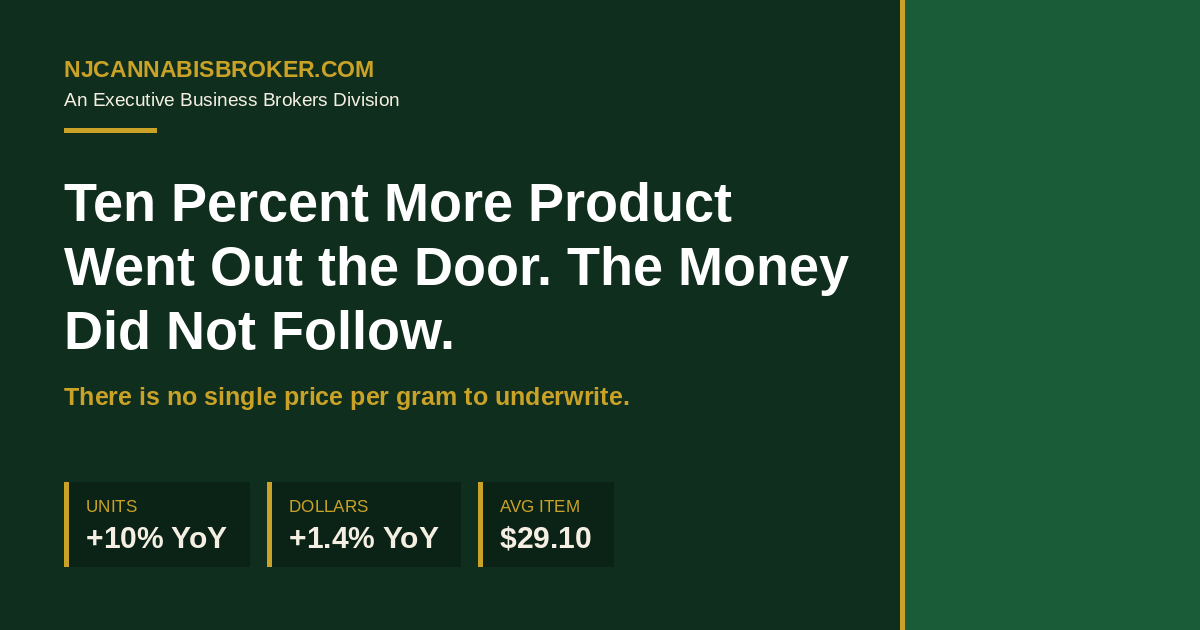
New Jersey dispensaries sold about ten percent more product in September 2026 than they did in September 2025. They took in one and a half percent more money for it.
Both of those numbers are true. A buyer who sees only one of them pays the wrong price.
Almost every out-of-state buyer I talk to arrives with a model, and almost every model has the same soft spot. It is not optimism about growth, and it is not the multiple. It is a single cell holding a price — dollars per gram, dollars per item, dollars per visit — carried across five years as though it were a fact about the market rather than a fact about one month and one package size. In New Jersey right now, that cell can be off by half and still be sourced honestly.
So here is one New Jersey operating year told twice: once the way the store experienced it, and once the way the money recorded it. Same twelve months. Two different businesses.
The year the store had
Busy. Per Headset's New Jersey market data for September 2026, snapshot dated October 3, stores moved roughly 3.3 million units, with unit volume up about 10 percent year over year. Beverages, still only half a percent of the market, grew units 45.9 percent. Nationally, Headset counted 482 million transactions across its sixteen markets, up 5.8 percent.
This is the year your seller lived and the year his staff will describe to you on a site visit. More customers, more baskets, more product off the shelf. Every word of it is accurate, and none of it is revenue.
The year the register had
Flat. New Jersey's September 2026 sales came to about $95.84 million, up 1.4 percent year over year against that 10 percent unit gain. The average item fell from $31.57 to $29.10. Nationally the average basket dropped from $49.10 to $47.03 on 2.74 items.
Roughly nine points of volume growth did not become money. If a seller's package shows you a growth story built on traffic, customers or units, you are looking at column one. The number a buyer actually pays for sits in column two.
The year the shelf had
This is where price per gram stops being a number. On Headset's New Jersey page for the same month, a single-gram package of flower averaged $13.23, while an eighth averaged $29.69 — which works out to about $8.48 a gram. Nationally the spread is wider still: $8.09 for a gram, $20.23 for an eighth, $47.83 for a full ounce, or $1.71 a gram.
All of those are real prices per gram. Headset defines the figure as total dollars divided by total units, net of discounts and before sales tax. Which one describes your target depends entirely on what size its customers buy — and they are buying bigger.
- Price basis. Dollars per gram, per item or per basket — and measured on which package sizes. Write the definition, not just the number.
- The month it came from. A September figure and a January figure are different assumptions. Put the date in the cell.
- Gross or net of discount. Shelf value and register value are not the same line, and the gap is widening.
- Unit trajectory, separately. Units and price move in opposite directions here. Model them as two assumptions, never one.
- Whose number it is. The seller's POS, a data vendor, or your own count of the receipts. Name the source beside the figure.
The year the discount line had
Quietly expensive. Headset's figures put discounting at 27.1 percent of shelf value nationally in the twelve months to September 2026, up from 23.6 percent. A June-to-June read published by mg Magazine on September 21, 2026 showed the same move, 22.8 percent to 26.0 percent, with average item prices down 3.3 percent while the effective price per gram of packaged flower fell 5.7 percent.
That two-point gap between sticker and register is the discount doing the work. More than a quarter of shelf value is now handed back at the counter, which means a menu price — the thing easiest for a buyer to verify — is the least reliable number on the premises.
The year the invoice had
Also falling, which is the part buyers get wrong in the other direction. CannaIntelligence put New Jersey wholesale flower at roughly $2,000 to $2,598 a pound in April 2026, after a record 14.2 percent weekly drop that March, against a US spot index of $1,015. Limited-license states still clear $10 to $18 a gram at retail where mature markets clear $4 to $8.
So a declining retail price is not automatically a declining margin. It also is not a floor. New Jersey's scarcity premium is a function of how little paper the state prints, and both sides of that spread are moving.
The year your model has to have
Stop underwriting a price. Underwrite two series — units and effective dollars per unit, each dated and each sourced — and let the product be your revenue line rather than the input. Then check what the error is worth. Dispensary comparables run roughly 3x to 6x EBITDA, with most closed deals landing 4x to 6x and cann.dev's April 2026 sector median at 5.27x. At five times, a $300,000 mistake in sustainable EBITDA is $1.5 million of purchase price.
Nobody has to guess at these inputs. The seller's point-of-sale system holds the unit counts, the discount totals and the package mix by month, and the buyers who move fastest in this market ask for that export before they ask for the P&L. Have your CPA price the tax effect and your cannabis attorney read the licence conditions; neither question belongs in a spreadsheet assumption.
A seller is not hiding anything when he shows you the busy year. He lived it. He hired for it. He genuinely believes the business grew, because by every measure he watches daily, it did. Your job is not to catch him out — it is to notice that the growth happened in units and the price moved the other way, and to price the business on the half of the year that reaches the bank. If you are looking at New Jersey opportunities and want the second column before you commit, that is the conversation to have early, not after the letter of intent.