Three New Jersey cannabis companies have now sued the state over the same two paragraphs of the law that licensed them.
One of them already won. The judgment covers that one company and nobody else.
The paragraphs are in N.J.S.A. 24:6I-36. You file an attestation signed by a bona fide labor organization confirming you have a labor peace agreement. Maintaining it, the statute says, "shall be an ongoing material condition" of the license, and failing to make a good faith effort toward a collective bargaining agreement within 200 days of opening "shall result in the suspension or revocation" of it. Conditional licensees and microbusinesses are carved out. Everybody else is in.
Here is the part owners get wrong. They read this as a fine risk, and a fine is a number you can write a check for. A notice of violation is not an event that happens to you once. It is a document other people's contracts have been quietly waiting for. Follow one out of the Commission's office and watch what it touches.
The renewal it rides along with
A notice of violation rarely arrives alone. In the suit filed this week, the complaint says the Commission signalled it would issue one alongside the company's upcoming license renewal. The first document it lands on is the one keeping the doors open, and that is a different problem from a penalty, because a renewal is a decision the state has to affirmatively make.
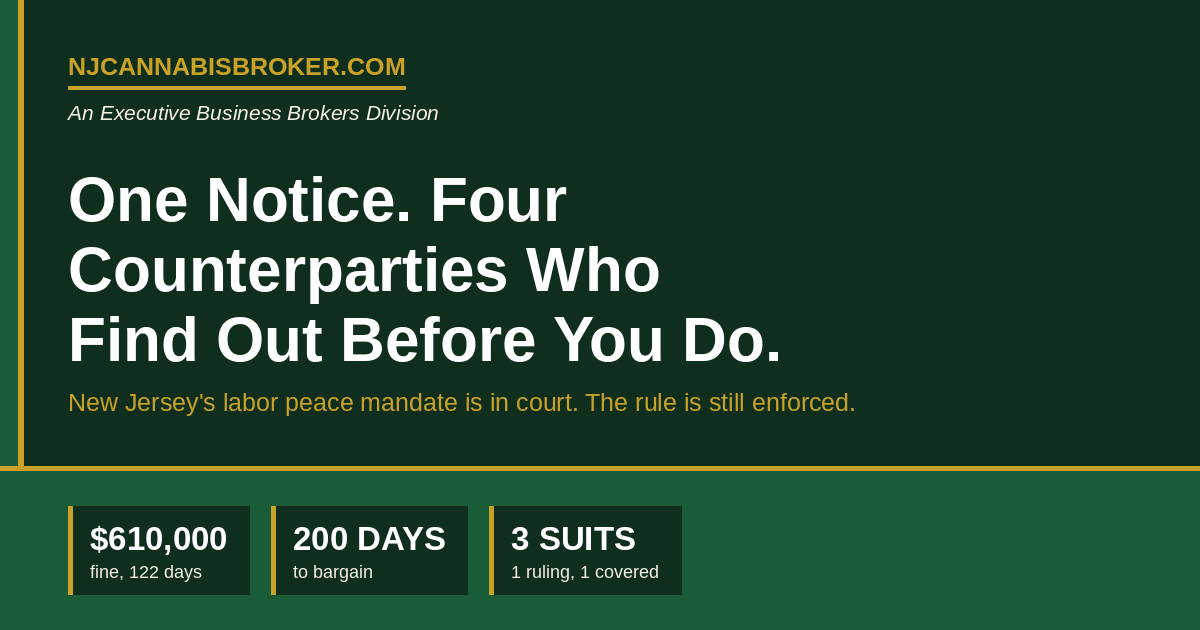
The scale is on the record. Curaleaf was assessed $610,000 for operating 122 days without an active agreement - roughly five thousand dollars a day - with revocation threatened alongside it. The Commission now has a documented basis to decline a renewal rather than grant one. That is a right it did not have the week before.
The bank that reads it before you do
Cannabis deposit relationships run on FinCEN's 2014 guidance, which sorts every marijuana filing into three buckets. A compliant operator gets a "Marijuana Limited" report - a thin filing saying the only unusual thing here is the industry. The second bucket is the one to understand.
A "Marijuana Priority" report goes in when the institution reasonably believes the business "implicates one of the Cole Memo priorities or violates state law." A state notice of violation is, on its face, a state law finding, and the complaint filed Monday alleges exactly this cascade. Your depository now has a right to re-file you in a worse category. The third bucket is called Marijuana Termination.
- Your lease. Find the compliance covenant and the cure period. Count the days.
- Your wholesale supply agreements. Look for termination for cause tied to license status, not to non-payment.
- Your deposit agreement. Find the clause letting the institution close the account on notice, and the notice period.
- Your labor peace agreement itself. Term, termination rights, and whether it says anything about the state mandate.
- Any purchase agreement or LOI on your desk. Read the regulatory compliance representation and ask whether you could sign it today.
The landlord with a compliance covenant
New Jersey cannabis space runs roughly $15 to $40 per square foot, triple net, on footprints between 800 and 4,200 square feet. These are not standard retail leases. The landlord's own permitted use depends on the tenant holding a license, so nearly all of them carry a licensure and compliance covenant, often with a shorter cure period than a commercial tenant would normally get.
That covenant does not usually wait for a revocation. It is frequently drafted to trip on a notice, a proceeding or a threatened action - the stage before anything is decided. The landlord now has a right to declare a default while you are still drafting your response to the Commission.
The supplier who is already paid in cash
You buy wholesale flower in New Jersey in the band of $2,000 to $2,598 a pound, in a market where banks will not lend, which means largely paying cash on short terms. Supply agreements here carry termination for cause tied to the buyer's license standing, for an obvious reason: a cultivator cannot legally transfer product to an entity that is not a licensee in good standing.
So the supplier is not being difficult when he pauses. He is managing his own compliance exposure - the same exposure that flagged your file. He now has a right to stop shipping, and you have no credit terms to argue with.
The buyer you have not met yet
This is where it reaches value. Every purchase agreement for a licensed business contains a representation that the seller complies with the regulations governing it, and in a cannabis deal that is one of the three load-bearing reps. Representation and warranty insurance will not paper over it either - those policies routinely carve out regulatory compliance and licensing, which are precisely the risks at issue.
An open item in the file does not usually kill a deal. It re-prices one. Escrows on 2025 transactions averaged 12.1% of value at a 10.0% median, and 14.7% with no insurance behind them. A buyer now has a right to ask for the high end of that range, and the cheapest place for him to put his concern is your holdback.
The ruling that protects exactly one company
Now the frame breaks, because the rule driving all of this is under attack. In Curaleaf Holdings, Inc. v. New Jersey Cannabis Regulatory Commission, No. 3:25-cv-16397, Judge Michael A. Shipp entered final judgment on August 10, 2026, declaring the requirement preempted by the National Labor Relations Act under the Garmon and Machinists doctrines. The May opinion found it "impermissibly conditions a state license on an employer refraining from conduct protected by federal labor law."
But the declaration was entered as applied to the plaintiff. The Commission appealed to the Third Circuit on August 13, 2026, and a ruling there would bind New Jersey, Pennsylvania and Delaware. Verano sued on July 31 over four ZenLeaf stores and a Branchburg cultivation site; the third suit landed Monday. The rule is still on the books and still enforced against everyone but one company. How that applies to your license is a question for your own labor and cannabis counsel.
If you hold a New Jersey license and are thinking about a sale in the next eighteen months, the labor file has quietly become a valuation document. Current opportunities sit on the listings page.
Owners treat a compliance item as a conversation with the regulator. It is never only that. The Commission is one counterparty; your landlord, your bank, your cultivator and your eventual buyer are four more, and three of them find out from a document they are contractually entitled to see.
What makes this one unusual is that the rule may not survive. That is not comfort, it is a timing problem. A legally unsettled requirement is the hardest thing in the world to represent cleanly in a purchase agreement, and a buyer who cannot get a clean representation does not walk away. He discounts. That is the whole exposure, and it is sitting in a file most owners have not opened since the day they signed it.