On December 7, 2021, the State of New Jersey disqualified a cannabis application over one missing page.
The applicant was Sunrise Organic Wellness NJ LLC, in New Jersey's 2019 medicinal round. The page was a Personal History Disclosure Form for a company manager who, under the applicant's own operating agreement, held significant management authority — and who appeared in neither Section 20 nor Section 21 of Part A. Everything else in that filing may have been outstanding. Nobody will ever know, because the review stopped at the gap.
That was a scored, competitive round under a rulebook that no longer governs new applicants. Today's adult-use process is rolling and far more forgiving. But the shape of the failure has not changed, and it is not the shape first-time applicants brace for.
New Jersey usually does not deny you. It hands the file back.
N.J.A.C. 17:30-7.2 is explicit. An application the Commission deems incomplete "because of failure to address all applicable criteria and measures or to provide requested information shall be returned to the license applicant with the opportunity to cure the deficiencies in a license application and resubmit it." The CRC calls that a Cure Letter. Resubmitting does not cost you your place: "your resubmitted application will be placed at the end of the highest-priority list, not at the end of the overall queue."
What it costs is a review cycle, while your lease, your town and your investors keep running on their original clocks.
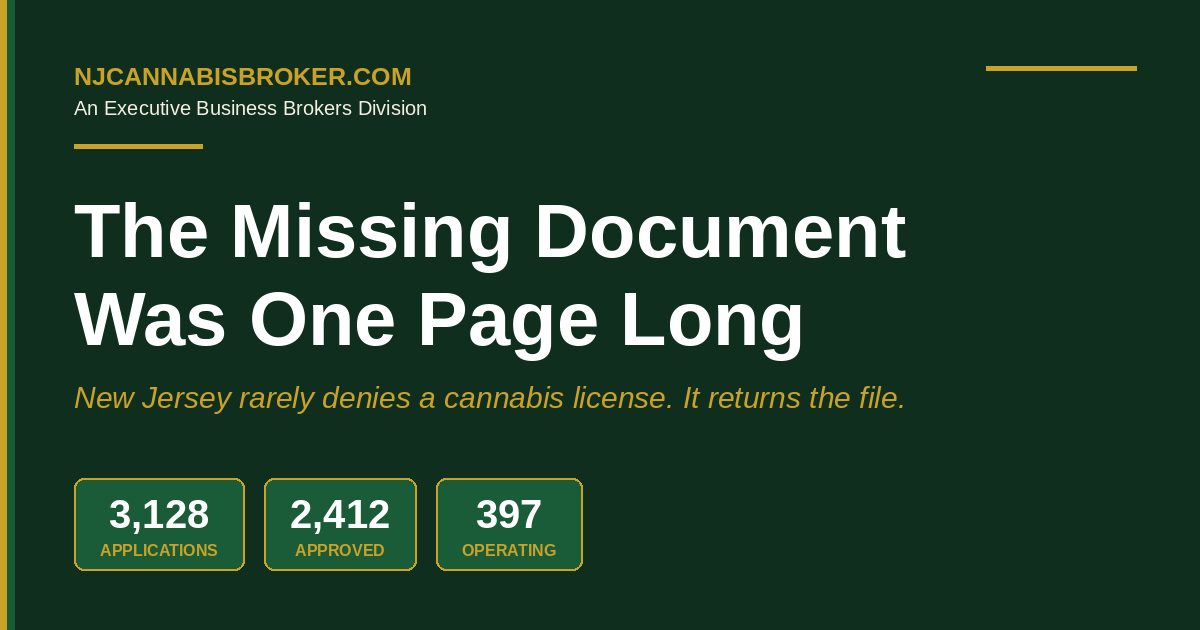
The aggregate numbers say the same thing from the other side. The CRC's 2025 year in review, published February 6, 2026, counted 3,128 applications received and 2,412 approvals — against 397 businesses licensed to operate as of December 17, 2025. Approval is not the bottleneck here. Opening is. So the useful question is not what gets an application denied. It is what sits in the empty spaces — and the Commission publishes that list itself.
1. The person who is not on the list
The deficiency the CRC names first is the Entity Disclosure Form — specifically the failure to file one for "any related entities providing financial or management support." Right behind it: persons of interest whose statement of truth and waiver of liability are unsigned or un-notarized. Understand what the reviewer does with it. They read your operating agreement against your disclosure list, hunting for anyone who holds authority in one document and is absent from the other. That is exactly what ended the 2019 application above.
2. The lease that is not signed
Site control is three documents, and the CRC lists all three: local support as a governing-body resolution, a zoning approval letter, and a signed lease. A letter of intent is not a lease. A landlord waiting to see whether you get licensed is not site control. This is also the item with the least slack — a conditional holder has 120 days to convert, extendable by 45, and the municipal piece is routinely the long pole, which is why the town's clock, not the State's, usually decides your timeline.
3. The tax return that is not the current one
Then the cluster that costs nothing to prevent and stops files anyway. The CRC asks for "your latest state and federal tax return," adding that "if submitting returns from a previous year, you must also provide proof of any extensions obtained." Government IDs must be "current at the time of submission" — an expired driver's license is a cure letter. Diversely-owned certifications have to be current on NJSAVI. Formation certificates must carry the applicant entity's exact name. None of that is judgment. It is filing discipline, and it is where the avoidable weeks go.
4. The agreement that is still a draft
Financial and management service agreements have to be finalized and submitted, not described as forthcoming. The CRC's applicant bulletin of October 8, 2025 frames it as "compliance over cash": an agreement that does not align with Commission rules and State law will hold the approval no matter how much capital stands behind it. If outside money is arriving with a management company attached, that contract is a licensing document before it is a business one — have your cannabis attorney read it in that order.
5. The procedures that belong to somebody else
Standard operating procedures come back marked non-compliant about as often as anything in the package. N.J.A.C. 17:30-7.10(b) itemizes nine SOP categories, inside a filing that separately wants six standalone plans — operating, business and financial, environmental impact, safety and security, community impact, workforce development. Bought templates do not survive that. And SOPs are the one item here that somebody reads again years later: a buyer's diligence team asks for them in week one, and a binder written for another state's rules reads as thin then as it does now.
6. The money that is no longer there
The CRC's own advice is "don't overspend early" — do not finish construction or exhaust investor funds before approval, because that money is gone whether or not the documentation clears. Set that against the calendar: four to five weeks of conditional review, twelve to twenty-six weeks for an annual, then three to twelve months of buildout and inspection. This is the real content of the gap between 2,412 approvals and 397 operating businesses. Most of those files were never rejected. They ran out of runway while waiting.
What actually gets you denied
N.J.A.C. 17:30-7.9 sets the grounds: the applicant is not qualified under 17:30-7.11, the application does not score high enough, material facts were not revealed, unsuitability is established by clear and convincing evidence, or the applicant submitted "false or intentionally misleading information."
Read those beside the cure-letter list and the asymmetry is the whole lesson. An omission gets your file returned. A misrepresentation gets it denied. Qualification also carries one hard threshold worth checking before you spend a dollar: at least one owner must have resided in New Jersey for at least two years. A written denial must state its reason, and the applicant has 45 days to request a hearing at the Office of Administrative Law — a road mapped by your own cannabis attorney, not by a blog post.
Five checks, none of which need a lawyer to start:
- 1. Print your operating agreement and your disclosure list side by side. Circle every name on one page and not the other. That is your deficiency list.
- 2. Pull every government ID in the file and check the expiration against today's date, not the date you gathered them.
- 3. Confirm the formation certificate carries the applicant entity's exact name, character for character.
- 4. Find every agreement still marked draft, unsigned or "to be executed" — financial, management, lease — and either finalize it or plan for the cure letter.
- 5. Write down what you will have spent by the day approval arrives, then add twelve more weeks of the same burn. If that number frightens you, fix it now rather than at month nine.
Two and a half thousand New Jersey applicants have cleared the State. Fewer than four hundred businesses are open. That spread is the most interesting number in New Jersey cannabis, and it points two ways at once.
If you are holding an approval you cannot fund, you are holding something with real value to somebody else — and a clock on it, because a business that never commences operations cannot transfer its license at all. If you are coming at this market from out of state, that same spread is why buying in is usually faster and often cheaper than building, and why the better deals are the quiet ones. Either way, the folder you assembled for the CRC is the folder a buyer asks for. Build it once, build it properly, and it does two jobs.
If you want to know what an approval or an operating store is worth in today's market, or you are looking at New Jersey opportunities from outside the state, that conversation is confidential and costs nothing.